
Table of Contents
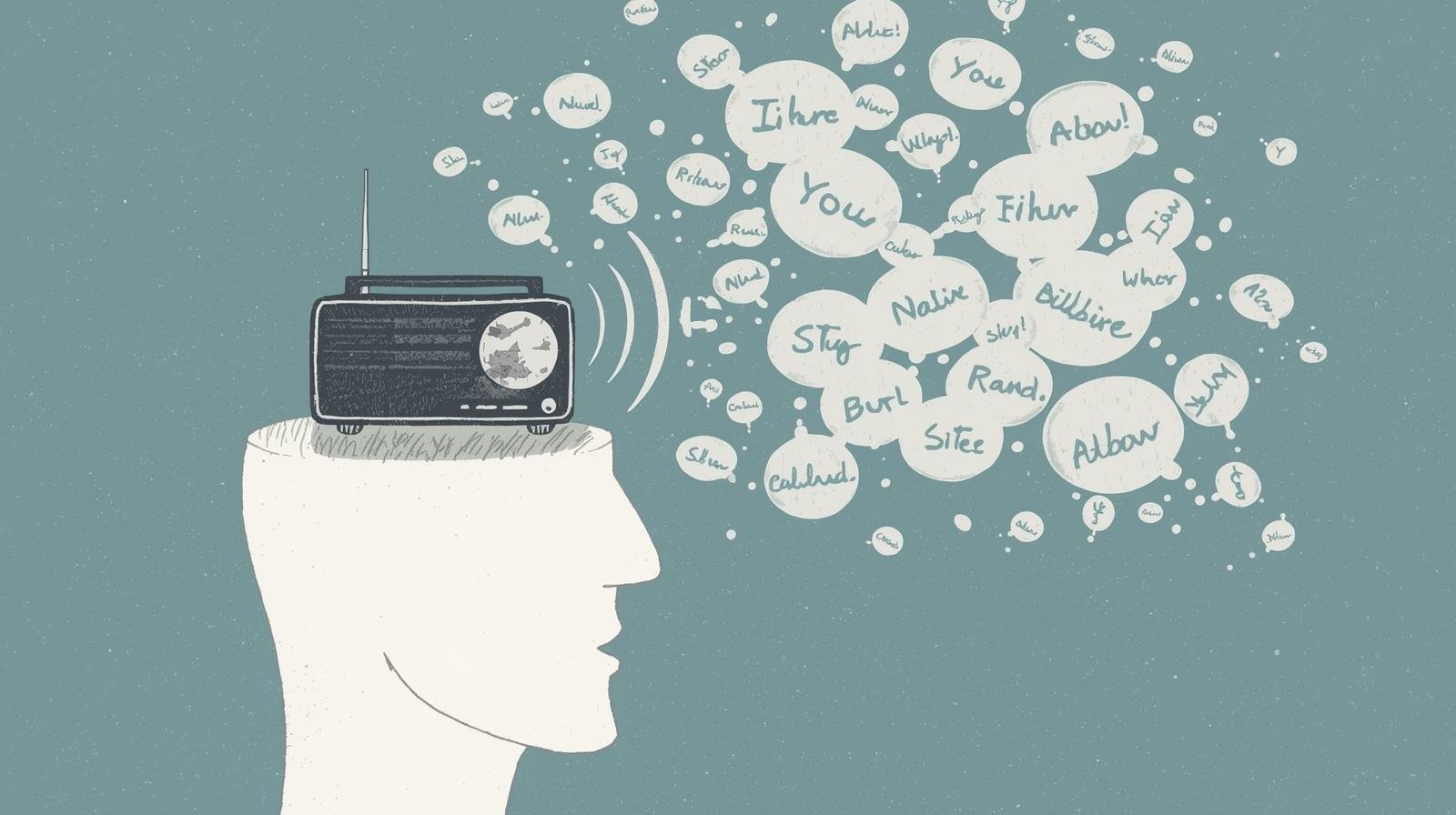
Hello again. Let’s talk about something that is always with us: the many thoughts that keep coming to our mind all the time, an endless stream often referred to as the ‘default mode network’ of the brain. This constant, unmanaged mental chatter is far more than background noise; it is a powerful force that shapes our reality, often for the worse.
The Trap of Overthinking: From Thought to Obsession
Consider this common, yet profound, experience: You are sitting with friends, engaged in lively conversation about various topics – the new movie, a recent trip, a funny story. Then, one normal, seemingly innocent word someone says – a place name, a feeling, a brief mention of an old connection – makes your mind instantly jump. It acts as a powerful, unscheduled trigger, yanking your consciousness back to an old memory right away. Suddenly, you are physically present, nodding and smiling, yet your mind is running a high-speed, internal video through that past time. You miss the next minute of the conversation entirely because your attention is captive to an internal rerun.
Or, think about a different, high-stakes scenario: you are in a very important corporate meeting, the kind where significant decisions are being made. Your boss or a senior colleague is outlining a new, big, complex strategic plan that demands your full analytical focus. But you are not listening. Instead, your mind is still fiercely engaged in a fight you had last night with a friend or a partner, mentally arguing your points over and over again. Alternatively, a difficult or critical email you read earlier is playing on an incessant loop, a constant, annoying, anxiety-inducing internal movie. The physical meeting continues around you, but your focus is miles away. Then, the inevitable happens: someone turns to you and asks a direct question for your input. You stumble, unable to offer a coherent answer because you were completely lost, marooned in the tumultuous sea of your own thoughts. The disconnect is embarrassing and, professionally, damaging.
The Failure of Willpower
How often do we not just have these thoughts, but get completely stuck in them – a process known as rumination?
We try desperately to stop the torrent of thoughts, to push them down deep, perhaps using sheer willpower, believing we can master the mind by force. But we cannot trick our minds easily; the subconscious is a relentless vault. That suppressed thought, often a worry or a perceived injustice, is just waiting for a small external cue—something you see, something you hear, or something you feel (a sudden tightness in your chest, a familiar scent) – to make it explode back into conscious awareness.
And when it returns, it is not the same small thought; it is much bigger, more complex, and heavily embellished. That one initial worried thought is now a whole paragraph of strong, visceral feelings, complete with imagined dialogue and emotional heat. This quickly grows into a long essay of trying to defend yourself, rationalize your position, or act with too much pride and self-pity. The worst part is the projection: we don’t just think bad, self-critical things for ourselves; we also make up long, intricate stories, often not true, about the motivations, intentions, and future actions of the people who were part of the first problem. We become novelists of our own psychological drama, and the genre is always a tragedy or a thriller.
This constant bad thinking, this unmanaged rumination, does much more than just make you forget a point in a meeting or miss a moment with friends.
The Breakdown of Authentic Connection
It fundamentally breaks the important, foundational link of clear and authentic communication. It severely hurts both work performance and personal friendships. Being lost in our internal world, it stops us from seeing others clearly, truly as they are. Instead, we look at them through a filter we have manufactured ourselves, a lens full of old worries, projected insecurities, or made-up slights and insults.
The Creation of False Reality
Most importantly, it creates a massive, often very damaging, difference between the situation we think it was -the story playing inside our head -and the situation it really was in objective reality. This internal narrative becomes our false reality.
Think of this powerful, yet deceptively simple, example: “Someone hands you a shiny, plastic, well-made coin and tells you, perhaps even uses pressure or manipulation to make you believe it is a real, valuable gold coin.” This sounds silly and easy to laugh at, right? You would never fall for such a basic trick. But aren’t we doing the same silly thing to ourselves every single day? We are constantly imagining the worst things that could happen, anticipating failure, and adding many layers of bad ideas and false significance on top of quick, neutral moments or things we understood wrongly. We willingly accept our own inner plastic coin of fear, worry, and projection as if it were the undeniable truth, as if it were pure gold.
I have told you the main problem: the strong, relentless, and harmful nature of thoughts that keep coming back, growing bigger, and distorting our perception. But the most important question, the philosophical and psychological “why,” is not answered yet. So let’s talk about that now. What is the actual mechanism operating in the thinking part of our brain? Why do we feel this compulsion, this irresistible urge, to build all these big, intricate, often negative mental ideas?
The “Grapevine” Effect in the Brain
Have you ever played the old kids’ game where one person whispers a sentence – often a silly or complex one – into the next person’s ear? The last person in the line says the message out loud. Most times, the final sentence is shockingly different, often nonsensical, from the first one. This phenomenon is known as Grapevine when talking about how information flows (and gets corrupted) within groups. Because the original message is passed through many individual minds, the first message is inevitably broken, filtered, and changed along the way. Every person, without malicious intent, adds their own unintentional part – a small error in hearing, a personal bias, a pre-existing idea, a slightly missed word – and the final message is a fundamentally twisted, unreliable version of what it was supposed to be.
Internal Repetition as Corrupting Link
This phrase describes a situation where an idea, theme, or piece of information is repeated too often within a specific system, organization, or piece of work, and this constant repetition starts to make the original idea less effective, distorted, or even harmful. The repetition acts like a “corrupting link” because it degrades the quality or integrity of what is being repeated.
In simple terms: When you say something over and over and over again, it can lose its meaning or even start to be misinterpreted or misused. The act of constantly repeating it is what spoils the original message.
Example:
Imagine a company starts a new campaign with the core value: “Customer Trust is Everything.”
- Initial Message: It is a strong, clear, and positive message.
- Repetition Begins: Management decides to hammer this message home. It’s in every meeting, every email signature, on posters in the break room, mentioned 10 times in every training session, and constantly cited as the reason for minor operational changes.
- The Corrupting Link: Over time, employees become desensitized.
- The phrase loses its emotional impact and becomes just corporate jargon.
- Some employees start using the phrase cynically – for example, citing “Customer Trust is Everything” as a justification to avoid extra work or to blame another department.
- The sheer quantity of repetition makes employees doubt its sincerity; they feel manipulated rather than inspired.
In this example, the internal repetition (constantly repeating “Customer Trust is Everything” within the company) acts as the corrupting link, turning a powerful core value into a hollow, ineffective, or even resented corporate slogan.
Now, this is exactly what happens inside our own minds when we engage in overthinking, worry, or rumination. When we play the same thought, memory, or piece of a conversation over and over, it is not a perfect, sterile copy. Every single time we “pass the message” to ourselves – every mental repetition – we unconsciously add something new to the cognitive structure. We are like the next, crucial link in this internal, destructive mental grapevine.
Categories of Cognitive Additions
What do we add?
When a memory is recalled, it is often not a perfect replay but a reconstruction that can introduce subtle, and sometimes significant, alterations. These changes move the memory from a factual record to a personalized narrative. The key elements that are frequently fabricated or altered during this reconstruction process include:
Emotional and Psychological Distortions
- New, Stronger Emotion: A feeling or emotional intensity that was entirely absent or negligible during the original event is retrospectively projected onto the memory. For instance, a minor annoyance in the moment is later recalled as intense anger or deep betrayal. This serves to align the past event with the current emotional state or narrative need.
- Hidden Feelings: A deeper, unseen emotion, perhaps one the person was unaware of or suppressing at the time, is now clearly identified and projected onto the memory. The memory becomes a vehicle for realizing a truth about the self or the relationship that was previously subconscious.
- Imagined Intention: An unsaid, unverified, or attributed motive is assigned to the other person involved. This transforms an ambiguous action into a deliberate act, often one that is malicious, manipulative, or dismissive, which in turn justifies the current emotional reaction.
- Overanalyzed Action: A simple gesture, tone of voice, or body movement is retrospectively examined with hyper-vigilance. This mundane action is then imbued with significant, often negative, meaning, where a simple fidget becomes a sign of guilt or insincerity.
Factual and Narrative Additions
- Fabricated Detail: A brand new, entirely fictional part of the conversation, setting, or event is unconsciously invented to fill a logical gap or to make the narrative more cohesive and emotionally satisfying. This might include an unsaid retort, a detailed description of the weather, or a non-existent witness, all serving to cement the revised story. These fabricated details often serve a supportive function, making the psychological distortions above seem more plausible.
All these small, self-generated additions help the story grow and morph in a way that is always different from the truth, and almost always more complex and overwhelmingly negative.
The Engine of Suffering
In the end, that one small, easy-to-handle black dot of truth on the vast white board of reality now feels like the whole board is covered in blackness. Our internal grapevine is the engine of our suffering: it systematically magnifies the bad things, distorts and changes the simple truth, and traps us in a psychological prison of bad, complex ideas that we built entirely for ourselves. The way out, then, is not to fight the thoughts, but to recognize the flawed transmission process of the internal grapevine.
This talk was about the tricky ways we create inner “problems” – those small blocks in our mind and feelings that really stop us from living well. We looked at how these inner things are made, often without us knowing, and how they mess up our clear thinking, choices, and calmness. The main point is that our troubles often come from inside, from the ways we think and feel that we let stick around.
The Focus of the Next Post
Moving on from this, our next blog post will switch from finding the problem to practical steps. Our next deep dive will be into the important topic of “How to Handle Our Thoughts.“ This post will not just explain what bad or unhelpful thoughts are, but more importantly, will give you a simple yet very good plan for dealing with them.
Key Strategy: Non-Judgmental Awareness
In short, we will show you a clear, step-by-step way to work with your thoughts differently. The main idea of this plan is learning to deal with these thoughts as they happen, without judging them. This way of not judging is key; it changes the focus from fighting or pushing thoughts away (which often makes them stronger) to just watching and noticing them. By doing this, you can start to greatly reduce the power these thoughts have over how you feel and act, helping you feel more peaceful and in charge inside.
We are excited to share this helpful, clear advice with you and support you on your path to better managing your mind and feelings.
See you in our next blog.
Leave a Reply