

A Simple Guide to Managing Stress Through Natural Breathing
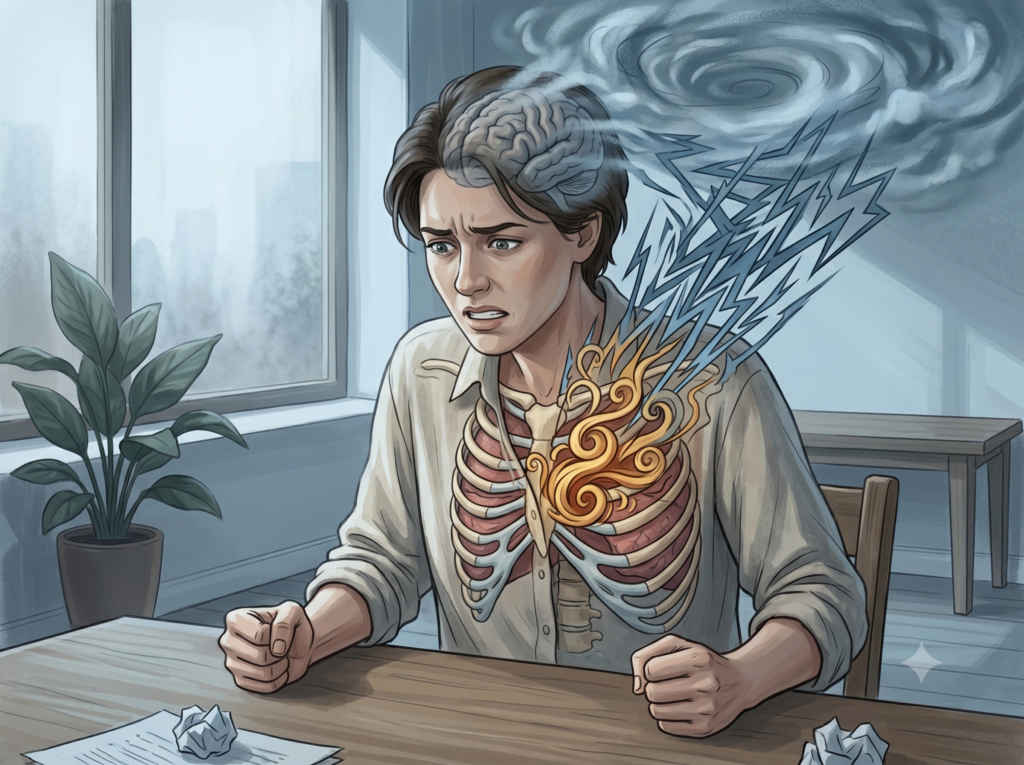
Imagine you are standing backstage, or sitting in your home office staring at the blinking cursor on a video call link. In exactly three minutes, you have to present an idea you have spent months perfecting. But right now, your biology feels like it is working against you. Your chest feels tight, your breathing is incredibly shallow, and a sudden wave of “mental freeze” has wiped your opening lines completely from your memory. Your brain is interpreting this high-stakes meeting not as an opportunity, but as a physical threat, flooding your system with stress hormones.
The traditional advice we often hear in these moments is simply to “be confident” or “calm down.” But true growth isn’t about magically conjuring up an emotion. It is about understanding and working with the natural rhythms that create our feelings. When your mind is too loud to listen to logic, your body can provide the path back to peace.
Welcome to the practice of mindful conditioning. We believe that emotional growth is an active, living practice. The mind and body are constantly talking to each other. To quiet the mind, we can start by soothing the body.
The most natural tool you have for this is called The Physiological Sigh. This isn’t just another exercise; it’s a deep-seated reflex that helps us reset. By turning this natural sigh into a gentle daily habit, you can find a reliable way to shift your state and move past the frustration of trying to “think” your way into being calm.
Understanding the Body: How We Breathe and Feel
To truly master this tool, we need to look at what is happening inside your chest when you feel overwhelmed.
The Problem: The Pulmonary Crisis
Deep inside your lungs are millions of microscopic, balloon-like air sacs called alveoli. These tiny balloons are incredibly important because they are where the critical exchange of oxygen and carbon dioxide takes place. When you are feeling relaxed, these balloons are plump and fully inflated. However, under stress, anxiety, or high arousal, human breathing naturally becomes shallow and rapid.
When your breathing is shallow, these little sacs begin to lose their spherical shape. They start to deflate and collapse inward. As they collapse, the surface area available to bring in oxygen and push out carbon dioxide shrinks dramatically.
The Chemical Alarm
As these alveoli collapse, carbon dioxide (CO2) begins to get trapped and accumulate in your bloodstream. Your brain acts as a 24/7 security system monitoring these CO2 levels. When CO2 spikes, your brain interprets this as a suffocation threat. It sounds the alarm, triggering a massive release of stress hormones, which makes you breathe even more shallowly, creating a vicious cycle of escalating panic.
The Path Back: Gentle Restoration
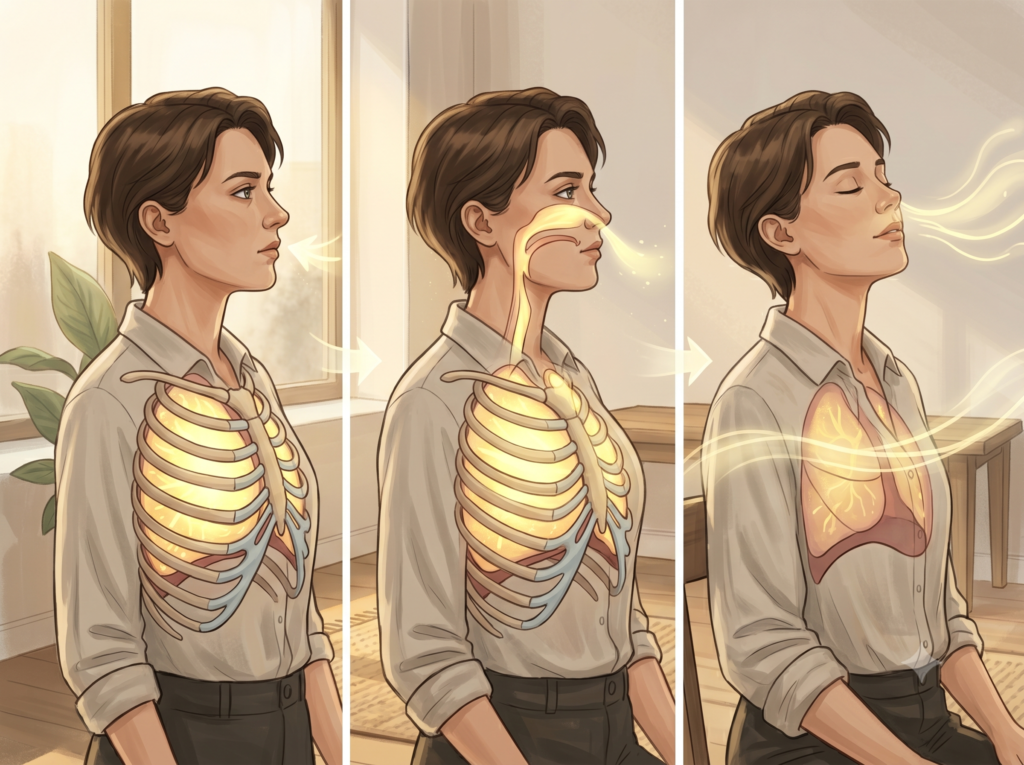
This is where the Physiological Sigh helps as a natural solution. It centers on a very specific “Double Inhale” that helps the body catch its breath.
Why two inhales? The first breath fills your lungs comfortably. But the second, smaller breath helps expand the lungs fully. This extra bit of air helps those tiny, deflated air sacs gently open back up, making more room for the fresh air your body needs.
Then comes the long, slow exhale. With your lungs fully open, this long breath helps clear out the built-up tension and carbon dioxide. By letting this breath go slowly, you signal to your brain that the danger has passed, allowing your whole system to relax.
The Neuroscience: Bypassing the Thinking Brain
To appreciate why this works so well, we can look at the brain’s natural rhythm center. Deep within our brain, there is a small cluster of cells that acts as a conductor for our breathing. It decides how fast or deep we breathe without us even thinking about it.
When a person experiences intense stress, their prefrontal cortex—the logical, reasoning, “thinking” center of the brain—essentially shuts down or becomes highly inefficient. Trying to use a compromised thinking brain to talk yourself out of panic (saying “just calm down”) is neurologically incredibly difficult. It is a slow, top-down approach that rarely works in the heat of the moment.
The Physiological Sigh works by talking directly to this rhythm center. By changing how you breathe, you send a clear message of safety to your brain. Your brain hears this and tells your heart to slow down and your muscles to soften. It is a way of inviting peace into the mind by first finding it in the body.
Making it Yours: The Daily Practice
We don’t want to wait for a stressful moment to try this. The goal is to nurture our nervous system every day so that breathing this way becomes second nature. It’s about caring for yourself through steady, gentle practice.
How to Practice (Step-by-Step)
- The Setup: Posture matters. Ensure your stomach and diaphragm are uncompressed. Sit or stand up straight.
- The Primary Draw: Inhale deeply through your nose. Pull the air deep into your belly, not just your upper chest. Stop just before you feel entirely full.
- The Second Breath: Without letting any air out, take a tiny, quick sip of air through your nose. This small addition helps expand your lungs fully.
- The Release: Let the air out slowly and fully through your mouth. Imagine you are gently breathing out through a straw. This long release is what helps your body settle and find its natural balance.
This is Day 1 of Speak Without Freezing.
What you just read is the first 15-minute drill from our July batch: Physiological Sigh ×5 rounds, then one sentence aloud. If that small shift in your chest just now felt like something, imagine it compounding for 30 days.
[Reserve your spot — July 11 batch, ₹999/month]
Integration into Your Routine
To make this part of your life, try to practice it in three ways:
| Phase | Frequency / Reps | Objective
|
|---|---|---|
| Conditioning (Proactive) | Daily / 3 to 5 Reps upon waking and before sleep | Trains the neural pathways and lowers your overall daily stress baseline. |
| Pre-Event (Strategic) | 2-3 Reps before difficult or critical tasks | Clears the mind for deep focus and prevents the stress response from ever starting. |
| Acute (Reactive) | 1-2 Reps right in the moment of panic | Immediate cessation of the panic response; quickly overriding a mental freeze. |
Real-Life Application: Seeing the Drill in Action
Because it is so simple and natural, you can use the physiological sigh anywhere. Here is how this practice can help in everyday life:
Scenario 1:
The High-Stakes Meeting
You are walking into a room full of evaluators or clients. Your body registers the evaluating eyes as a physical threat, and your heart rate climbs. Instead of silently panicking, you sit down, organize your notes, and seamlessly perform two physiological sighs. Your heart rate visibly drops. Your logical brain is prioritized, and your pitch is delivered with clarity and authority rather than rushed anxiety.
Scenario 2:
The Difficult Conversation
You must deliver critical feedback to someone or have a tough conversation with a partner. You anticipate conflict, so you subconsciously hold your breath and tense your jaw. Before opening your mouth to speak, you perform the drill. This instantly down-regulates your own defensive posture, allowing you to communicate from a place of calm understanding rather than reactive aggression.
Scenario 3:
The Creative Block
You have been working on a project for hours, but the ideas just aren’t coming. You feel restless and tired. By stepping back and taking a few deep sighs, you help clear that heavy feeling in your chest. You give your mind a fresh start, allowing your creativity to flow again naturally.
Conclusion: Embracing Our Natural Rhythm
We have seen how even the smallest parts of our bodies respond to stress and how we can find our way back to balance. Growth is a personal journey of getting to know ourselves better and learning how to care for our well-being.
Real change comes from how we treat ourselves every day. By learning to work with your breath, you are learning how to be your own best support in difficult times.
Take a moment now. Sit comfortably, let your shoulders go, and take that deep double breath. Feel the calm of your first intentional sigh. Listen to your body, and let it lead you back to peace.
Daily Drills · Speak Without Freezing
30 days. 15 minutes. Mon–Fri. Starts July 11.